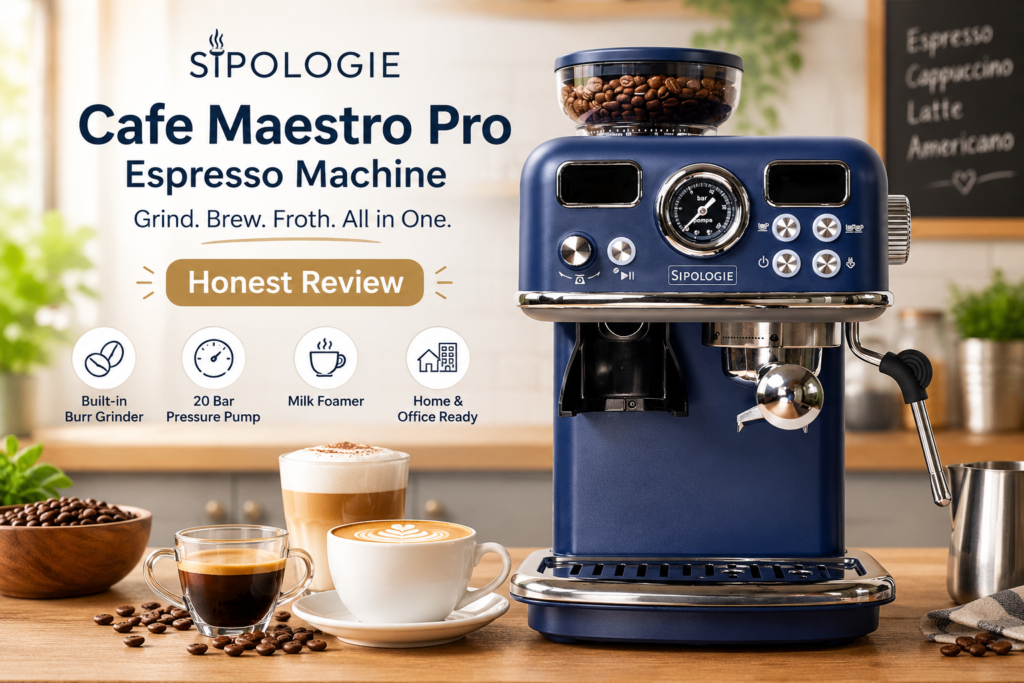
Making café-style coffee at home becomes much easier when a machine combines an espresso maker, a coffee grinder, and a milk frother in one compact unit. The Sipologie Cafe Maestro Pro Espresso Machine is designed around precisely that idea. With its built-in burr grinder, advertised 20-bar pressure pump, manual steam wand, and quick-heating system, it aims to give home coffee lovers more control over their daily coffee without requiring several separate appliances.
But an impressive feature list does not automatically translate into consistently good espresso. Customer experiences with the Cafe Maestro Pro are notably varied. Many owners appreciate its convenience, appearance, freshly ground coffee, and ability to prepare cappuccinos and lattes. Others raise concerns about espresso extraction, heating-related errors, pressure performance, and long-term reliability.
So, is the Sipologie Cafe Maestro Pro a sensible investment for your kitchen or office, or should you consider a different espresso machine? The answer depends largely on your coffee-making expectations, willingness to learn the controls, and plans for long-term use.
Check the latest price and availability on Amazon.
An All-in-One Design That Saves Counter Space
The Cafe Maestro Pro’s biggest practical advantage is that it combines coffee grinding and espresso brewing in one machine. Instead of purchasing a separate grinder and finding space for multiple appliances, you can grind your beans and prepare your drink using a single setup.
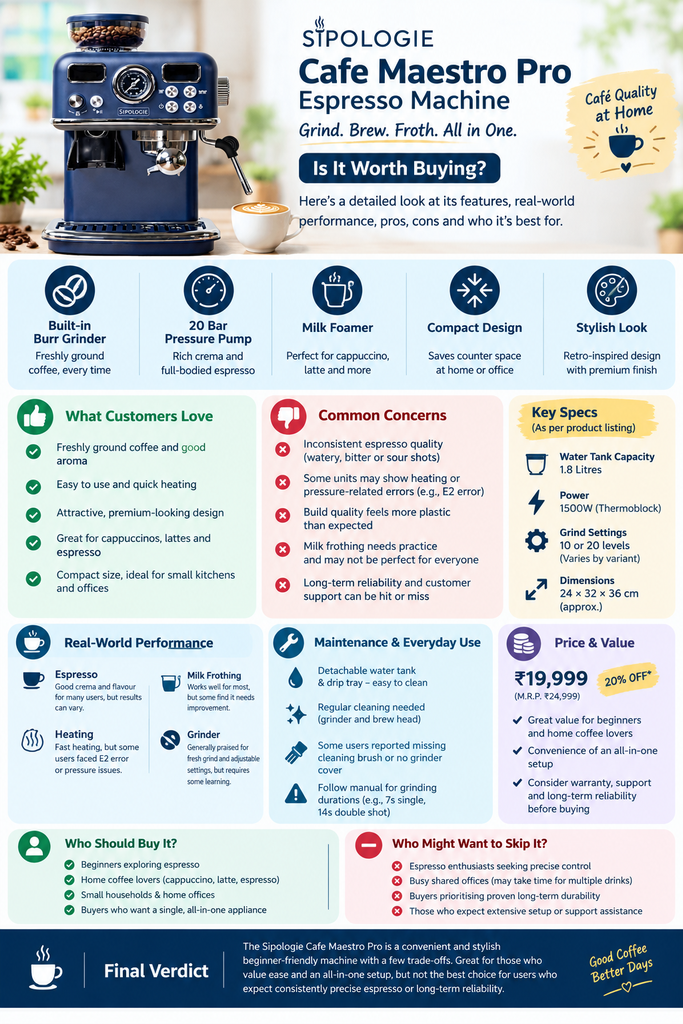
This arrangement is particularly useful for apartments, home kitchens, and small office counters. The machine measures approximately 24 × 32 × 36 cm, according to the product listing, so it is relatively compact for an appliance that incorporates a grinder and milk-frothing system.
Its retro-inspired styling is another appealing feature. Several owners praise its appearance and describe the machine as attractive enough to become a permanent part of their kitchen or coffee station. Positive comments about its finish and perceived build quality suggest that its presentation is an important part of the ownership experience.
However, perceptions of build quality are not entirely consistent. While some owners describe the machine as sturdy and premium-looking, a critical review characterises its construction as predominantly plastic and less solid than expected. The practical conclusion is that the Cafe Maestro Pro may look more premium than some buyers anticipate from its materials, so expectations should remain realistic.
The Built-In Burr Grinder Is a Major Advantage
For people who enjoy fresh coffee, the integrated burr grinder is arguably the machine’s most useful feature.
The product listing describes a grinder with adjustable grind settings and a timed grinding function. The listing’s specifications and description differ on the number of settings: one section mentions 20 levels, while another refers to 10. Buyers should verify the settings on the exact variant they intend to purchase rather than assume both descriptions are consistent.
In everyday use, grinding beans immediately before brewing can make the coffee routine more convenient and help preserve the aroma associated with freshly ground coffee. More importantly, adjustable grinding gives users an opportunity to experiment with different beans and extraction results.
Customer feedback on the grinder is generally encouraging. Several owners praise its convenience and grinding performance, with some reporting good fine-ground coffee and satisfying espresso after adjusting their settings. One owner specifically highlights the ability to adjust grinding time for single and double shots.
There is still a learning curve. Grind size and the amount of coffee used can influence how the shot extracts, so the first attempt may not produce the desired taste. A setting that works with one coffee bean may not deliver the same result with another.
The grinder also introduces a small maintenance consideration. One owner recommends following the manufacturer’s suggested grinding durations—approximately seven seconds for a single shot and fourteen seconds for a double shot—to avoid grinding excess coffee. The same review notes that removing the hopper could be less convenient without a locking mechanism to prevent beans from spilling.
For beginners, the built-in grinder makes the process simpler by reducing the number of separate purchases. For experienced espresso enthusiasts, its adjustment range and consistency will matter more than the mere presence of a grinder.
Espresso Quality: Encouraging Results, but Not Guaranteed
The Cafe Maestro Pro is marketed around a 20-bar pressure pump and the ability to prepare espresso with a rich crema. Its pressurised portafilter is intended to make espresso preparation more approachable for home users.
Customer experiences show why it is important to distinguish these specifications from actual brewing results.
Many owners report aromatic espresso, smooth coffee, and attractive crema. Some also describe successful results when using freshly ground beans and after spending time adjusting the grind size and coffee quantity. These experiences suggest that the machine can satisfy users seeking an accessible introduction to espresso at home.
Other buyers report watery, bitter, or sour shots, while some say their coffee did not develop the crema they expected. These complaints are important because espresso quality is the central reason to purchase this type of machine.
One longer-term owner also reported a decline in water pressure after approximately a year of use and two cleaning cycles. Another reviewer questioned whether the pressure gauge reached the advertised maximum. These are individual reports rather than proof that every unit suffers from the same problem, but they raise reasonable questions about consistency and durability.
The advertised 20-bar figure should not be treated as a guarantee of superior espresso. A pump’s stated pressure alone does not establish the quality of the finished drink. Grind size, coffee quantity, extraction conditions, and the machine’s actual operation all matter.
For a beginner who wants to experiment with espresso, the Cafe Maestro Pro may offer a useful starting point. For someone who expects highly repeatable shots and precise control over every stage of extraction, the mixed feedback deserves closer attention.
Explore the Sipologie Cafe Maestro Pro on Amazon.
Milk Frothing for Cappuccinos and Lattes
The machine includes a manual steam wand for heating and frothing milk. This makes it suitable for people who prefer milk-based drinks rather than espresso alone.
Several customers report satisfactory frothing performance and enjoy preparing cappuccinos and lattes at home. For households where different people prefer different drinks, having espresso brewing and milk frothing in one appliance is a meaningful convenience.
However, the feedback is not uniformly positive. One owner specifically says the grinder and pump perform well but that milk frothing needs improvement. This suggests that buyers should not assume the steam wand will automatically produce the texture they want for every drink.
Manual frothing also requires some practice. The result depends on technique and how the milk is handled, so beginners may need time to develop a consistent routine.
For everyday cappuccinos and lattes, the wand adds versatility. Those who place a high priority on repeatable milk texture or advanced latte art should examine the available demonstrations and operating guidance before buying.
Quick Heating and Everyday Convenience
The product description lists a 1500W thermoblock heating system designed to heat the machine quickly. Several owners support the general convenience claim, describing relatively fast heating, straightforward operation, and an easy transition from setup to making coffee.
These qualities make the Cafe Maestro Pro appealing for a morning routine or a shared office coffee station. Users do not need to operate a separate grinder, and the basic process appears manageable for many first-time owners.
There are, however, some practical qualifications.
One customer reports encountering an E2 error associated with the machine becoming hot. Another reviewer describes the machine heating up quickly but also experiencing the same error. A separate owner suggests opening the steam knob briefly to release pressure as a way of resolving the error, but this is an individual user’s suggestion rather than a verified universal fix. Consult the manufacturer’s instructions or support before attempting troubleshooting.
Initial setup may also require attention. One buyer reports that air trapped in the pump or system affected operation on arrival and that repositioning the water tank resolved the issue. This does not establish a widespread defect, but it is a reminder to follow the startup instructions carefully before judging the machine’s performance.
The overall picture is one of convenience with a modest learning curve, rather than a completely effortless plug-and-play experience for every owner.